THE LORD’S TABLE IN THE LIGHT OF THE PASSOVER
Rev. Marvin J. Rosenthal
The Jewish feast of Passover commands respect of all enlightened people. It stands in stately, majestic solitude as the oldest, continuously observed religious holiday upon the face of the earth. The Passover has been kept every year for more than thirty-four centuries – not only in the land of Israel, but in the countless lands where the Jews have lived during their extended exile. The miraculous longevity and perpetuation of Passover, in spite of what can only be termed humanly insurmountable difficulties, can be traced to the divine command,
And thou shalt show thy son in that day, saying, This is done because of that which the Lord did unto me when I came forth out of Egypt … Thou shalt therefore keep this ordinance in its season from year to year (Ex. 13:8-10).
Although Passover was a distinctly Jewish holiday, it has transcended national boundaries to become eternally and irrevocably entwined with “biblical” Christianity.
The Importance Of The Passover For The Christian
The spiritual clock was about to strike midnight. Mankind’s darkest hour was approaching. Thirty-three years earlier the “Day Star” had made His appearance. The eternal Son of God had stepped across the stars to be born in a Jewish manger. He was David’s greater Son; the Lion of the tribe of Judah; the King of the Jews; the Light of the world. His birth was miraculous; His life sinless; His teaching flawless. The one requisite for the establishing of His earthly kingdom was repentance; that requisite was not met. Now He would accomplish the supreme purpose for His first advent. He would die for the sins of the world. The direct light of the visible presence of the Son of God would soon flicker and fade. One desire still remained. In the upper room, just outside the walls of Jerusalem, Jesus said to His disciples,
With desire I have desired to eat this passover with you before I suffer (Lu. 22:lSb).
The Passover lamb was a suffering lamb – but through that suffering, redemption was provided for Jews enslaved by Pharaoh in Egypt. In a matter of hours now, Jesus would become the suffering Lamb – He would die on the cross of Calvary for the sins of the world. That death would redeem men of faith from enslavement to sin, Satan, and this world. The Lord .received strength and encouragement from observing the Passover before He became the Passover. It served as a vivid reminder that His death would not be in vain.
In the time of Christ, two days were acceptable or the slayin0 of the Passover lamb. The priesthood required the additional time to accommodate the great crowds which gathered to observe the feast. Even today, the first two days of Passover hold special significance. Jesus doubt-less observed the Passover the first day and was Himself the Passover on the second day. The Apostle Paul clearly established the relationship between the Passover lamb and Christ’s death as type and anti-type, shadow and substance. To the church at Corinth he wrote, ” … Christ, our passover, is sacrificed for us” (1 Cor. 5:7). It is impossible to exhaust all that was involved in the vicarious, substitutionary death of the Son of God, but an understanding of the Jewish feast of Passover serves to give additional insight into that lofty theological theme.
Two ordinances were given to the Church: believers’ baptism and the Lord’s Table. Baptism is a once-and-for-all ordinance – never to be repeated. The Lord’s Table is a recurring ordinance, observed in most churches at least once a month. Even a salient study of the Communion reveals that it was from the Jewish Passover that the Lord’s Table was instituted (Mt. 26:26). The Communion can be fully understood only in the light of the Jewish Passover, out of which it was instituted.
Background Of The Passover
There was only one Passover – only one occasion when the blood was applied to the doorposts and lintels of believing homes – only once that the angel of the Lord went through Egypt to smite the firstborn where the blood was not applied. Every succeeding Passover was a memorial of that first occasion.
Passover falls on the fourteenth day of the Hebrew month Nisan, corresponding to March/ April. Since the Hebrew calendar follows a lunar year, its exact date changes on the English calendar each year; however, it always occurs near the Christian holiday of Easter. If it is remembered that Jesus observed the Passover and the next day was crucified, it becomes easy to see why the two holidays coincide. Regrettably, at the Council of Nicene in 325 AD., the church, which had been commemorating the death and resurrection of Christ at Passover, changed the date for observing the resurrection to make it correspond with the pagan carnival called Easter – instead of the Jewish feast of Passover.
Every year Jewish families congregate around _a festive table on the first night of Passover, and in the course of a picturesque ceremony called the “Seder,” parents perform the religious duty of telling their children the story of the beginnings of their people and redemption from Egypt. During the Seder, the head of the home or master of ceremonies reclines on a pillow. In Egypt, Jews were slaves and slaves were not permitted to recline while eating. They ate standing and then hastened about their master’s business. The reclining is a picturesque reminder that they are no longer slaves, but free men – redeemed from Egypt through the slain lamb. It was that truth which the beloved Apostle John portrayed when he put his head on the Lord’s bosom (Jn. 13:23).
Original Elements On The Passover Table
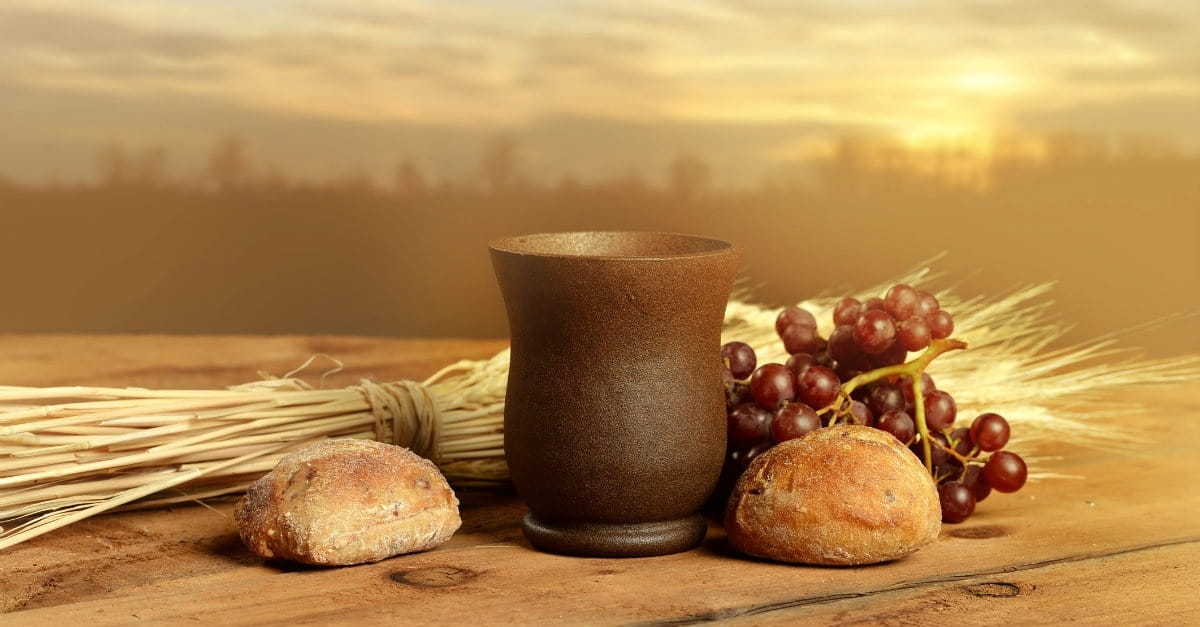
Originally, there were three elements on the Passover table: the Passover lamb, the unleavened bread and the bitter herbs (Ex. 12:8). The lamb symbolized redemption. Every firstborn in Egypt was under the judgment of God; wherever the blood was not applied, the firstborn died. Spiritually, every man is “firstborn” and under the judgment of God. Man must be born again, or born a second time, to experience God’s redemption. The unleavened bread symbolized sanctification. Leaven in the Bible speaks of evil and error. Having been redeemed from Egypt, the Jewish nation was to put away “leaven” – their former manner of life – and live a holy life unto the Lord. To the new nation, God said, And ye shall be holy unto me; for I, the Lord, am holy … (Lev. 20:26).
During Passover, leaven is scattered throughout the house and then meticulously swept into a dustpan and burned or thrown out of the house. This is done to symbolize the discarding of that which is unholy. The Apostle Paul had this in mind when he penned the Epistle of Romans. In chapters 1-5, Paul’s writings are a commentary on Passover – how is a man redeemed? Then in chapters 6–8, he comments on the unleavened bread – how is that redeemed man now to live?
The bitter herbs are a reminder that the lot of their forefathers had been harsh as slaves under Pharaoh. Each member of the family partakes of the bitter herbs until tears come to their eyes. In so doing, they vicariously identify with their forefathers who were slaves before God redeemed them through His mighty power.
According to the esteemed rabbi, Hillel, the lamb, the unleavened bread and the bitter herbs were the only elements on the Passover table as late as 10 AD. Additional elements, which will be discussed below, were added after 70 AD. Two events occurred between 10 AD. and 70 AD. to radically alter the Passover table: First, the crucifixion of Christ about 30 AD.; and secondly, the destruction of the Temple by the Romans in 70 AD. Christ’s death forever altered the Passover – no longer would an animal sacrifice be efficacious; Christ had died and the blood of bulls and goats could no longer cover sins. The destruction of the Temple and cessation of the priesthood made it impossible to perpetuate the Passover as God had instituted it.
Three choices were open to the Jewish people: (1) accept Christ as the Passover Lamb; (2) discontinue the Passover observance; or (3) without divine authorization, alter the Passover observance to meet the contemporary situation. Regrettably, most of the nation followed the latter course, and Judaism, which had its origin in God, became simply the creation of man. How tragic and descriptive the words of the Apostle Paul,
For they, being ignorant of God’s righteousness, and going about to establish their own righteousness, have not submitted themselves unto the righteousness of God (Rom. 10:3).
Clearly then, the additional elements added to the Passover table cannot be considered prophetic pointing toward Christ, since they were added after His death. Rather, they are historic, pointing backward to something that had already occurred.
Why Additional Elements?
A roasted egg and wine are new elements on the table. The Passover lamb, no longer present, is replaced by the shankbone of a lamb. The unleavened bread is still on the table, but arranged differently and has taken on new meaning.
The rabbis suggest that the roasted egg commemorates the sacrifice that in Temple times was offered on each festival. There is, however, no justification for that identification. Rather, in many heathen religions, the “pasche” egg was used to symbolize resurrection – life from out of the dead. From this heathen practice, the egg found its way into the Easter holiday and onto the Jewish Passover table. It speaks clearly and uncompromisingly of the resurrected Passover lamb.
Drama Of The Matzo
Perhaps the most dramatic spectacle on the Jewish Passover table involves the unleavened bread. Three pieces of matzo are placed one on top of the other, separated by special napkins. The center or second piece of matzo is broken, wrapped, and hidden away. After drinking the third glass of wine, called the “cup of blessing,” the children are sent out to locate the hidden piece of matzo. When it is found, a reward is given, there is much rejoicing, and everyone at the table “must eat” from that broken piece of matzo. Jewish authorities are hard-pressed to explain the significance of this drama.
The broken piece of matzo is called the “afikomen.” Jewish scholarship suggests, “This word may be connected with a Greek term having something to do with after-meal entertainment or dessert.” Factually, to rabbinic consternation, the three pieces of matzo speak of the triune God – Father, Son and Holy Spirit. The centerpiece depicts the Messiah (Christ). This piece of matzo is taken out from between the other two pieces – “broken” because His body was broken – “wrapped” because His body was wrapped in preparation for the grave – “hidden” from view because He lay three days unseen in the tomb. The “afikomen” is always brought forth after the third glass of wine because He arose on the third day. The broken piece of matzo then takes the place of the Passover lamb, and every one present must partake of it. Inexplicably, “afikomen” is the only Greek word in the Seder ceremony. It simply means -“I came” (second aorist of the verb “ikneomai”).
Interestingly enough, a great many traditions have evolved concerning the “afikomen, ” almost all suggesting a supernatural element. Worthy of note is the fact that presently Moroccan Jews save a piece of the” afikomen” throughout the year. When taking a sea voyage, they carry it aboard ship, convinced that throwing a piece of the” afikomen” into a storm will still the waters. It is not difficult to see the source of such a tradition. Jesus spoke and stilled the waters on the storm-tossed Sea of Galilee.
Christ Portrayed In The Jewish Passover
“How,” it may be questioned, “did so much which points to Christ find its way into the Passover observance?” The answer is really not complex. With the destruction of the Temple and the cessation of the priesthood, it was no longer possible for Jews to observe the Passover as they had for more than 1,400 years. Not only was their Temple destroyed and their priesthood temporarily terminated, but they were scattered throughout the world. Among these scattered Jews were some who were Hebrew Christians; men and women who had seen in Jesus Christ of Nazareth, their Messiah – the One who alone fulfilled the Old Testament messianic prophecy.
The Lord’s Table Instituted
These early Hebrew Christians introduced New Testament truth into the Jewish Passover. The penetrating words of the Lord during the last Passover could never be erased from their minds and hearts.
And as they were eating, Jesus took bread, and blessed it, and broke it, and gave it to the disciples, and said, Take, eat; this is my body (Mt. 26:26).
This is precisely what the Jews do with the “afikomen.” According to the rabbis, that broken piece of matzo takes the place of the Passover lamb, and must be eaten by everyone present.
And he took the cup, and gave thanks, and gave it to them, saying, Drink ye all of it; For this is my blood of the new testament, which is shed for many for the remission of sins (Mt. 26:27-28).
The wine on the Passover table was used as a symbol of His blood soon to be shed. It is for this reason that the rabbis unknowingly insist there must be wine and that it must be red. This was the New Covenant, and covenants were always confirmed with blood.
But I say unto you, I will not drink hence-forth of this fruit of the vine, until … I drink it new with you in my Father’s kingdom (Mt. 26:29).
Four cups of wine are consumed during the Jewish Passover. The fourth cup is the “cup of anticipation.” Jesus was saying that He would not drink it then (He had been rejected), but would drink it when He comes back again to establish His kingdom at the end of the Tribulation when He will be warmly received (Zech. 12:10).
And when they had sung an hymn, they went out into the Mount of Olives (Mt. 26:30).
The hymn which the disciples sang, and Jews continue to sing at Passover even to this day, is the “Hallel,” which is composed of Psalms 113-118, with special emphasis placed on Psalm 118:22-24 where, referring to Christ and Israel, the Psalmist says,
The stone [Christ] which the builders [Israel] refused is become the head of the corner (Ps. 118:22).
But perhaps even more amazingly, referring to His imminent crucifixion, Jesus sang,
This is the day which the Lord hath made; we will rejoice and be glad in it (Ps. 118:24).
Israel celebrated the Passover, but she experiences no redemption. She has on her Passover table the shankbone of a lamb, but no lamb. For nineteen centuries the “afikomen ” has yearly cried out, “I came.” What greater irony and tragedy than this – religious Jews continue to await the coming of Him who already came. The words of the Savior echo through the corridors of time to the twentieth century:
O Jerusalem, Jerusalem, thou that killest the prophets, and stonest them who are sent unto thee, how often would I have gathered thy children together, even as a hen gathereth her chickens under her wings, and ye would not! Behold, your house is left unto you desolate. For I say unto you, Ye shall not see me henceforth, till ye shall say, Blessed is he that cometh in the name of the Lord (Mt 23:37-39).
It was from the Jewish Passover that Jesus instituted the Lord’s Table, and in the observance of that Table, the Passover finds its perfect consummation. The simplistic words of John the Baptist are the most sublime ever uttered. Referring to Jesus, he said,
…Behold the Lamb of God, who taketh away the sin of the world (Jn. 1:29).
Christ died once and for all – the just for the unjust. Men of faith, both Jew and Gentile, find in Him alone the wellspring of eternal life.
Would you like to have a one-to-one Bible Study session?
If so, just send your name and email in the form below, or call Mike 087-7909515 or Seamus 087-2432944 and we can arrange something that’s suitable.